2025-10-20
The probability of AND involves multiplication: \(P[A \& B]=P[A]\times P[B|A]\)
If the two are independent : \(P[B|A] = P[B]\)
Therefore, for independent events: \(P[A \& B]= P[A]\times P[B]\)
The probability of A OR B involves addition:
\(P[A \text{ OR } B] = P[A] + P[B] - P[A \text{ & } B]\)
\[\huge{P[A|B] = \frac{P[B|A]\times P[A]}{P[B]}}\]
What proportion of women (ages 40-49) whose 1st mammogram suggests they have breast cancer actually do have breast cancer?
About 20 in 1000 women (ages 40-49) have breast cancer.
A mammogram will reliably detect breast cancer in ~ 920 of every 1000 patients who truly have cancer. (this is called a true positive” result)
A mammogram will incorrectly diagnose 100 of every 1000 cancer free patients as having cancer. (this is called a “false positive” result)
[work in pairs]
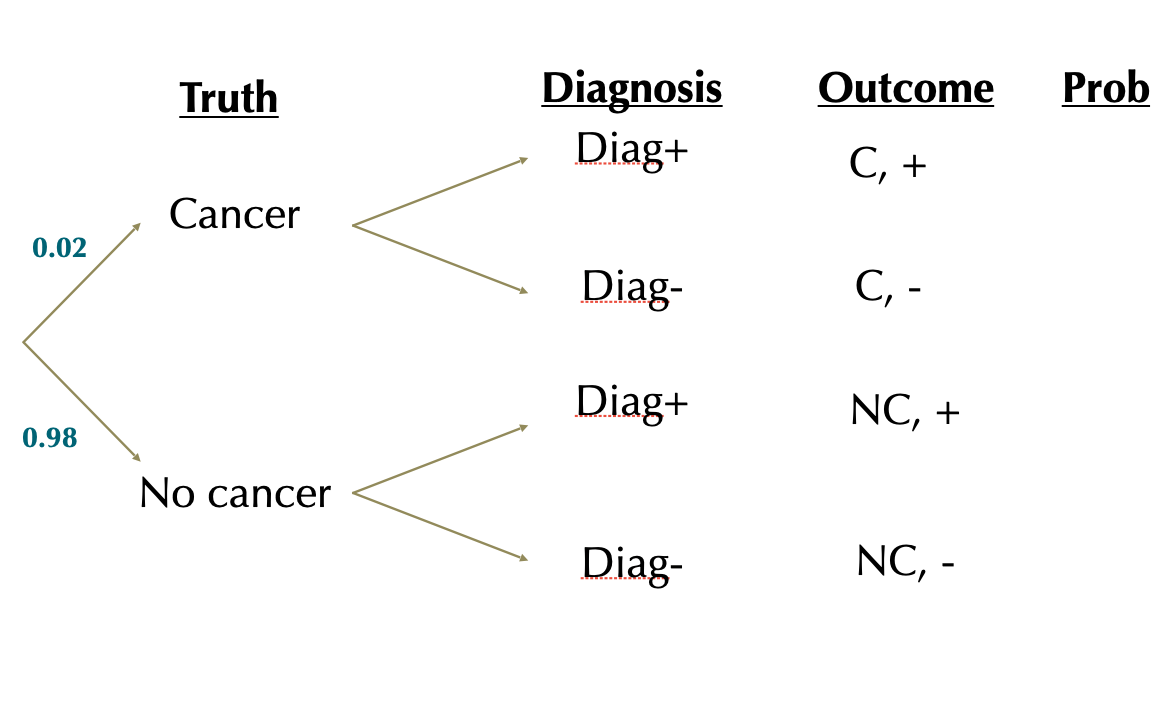
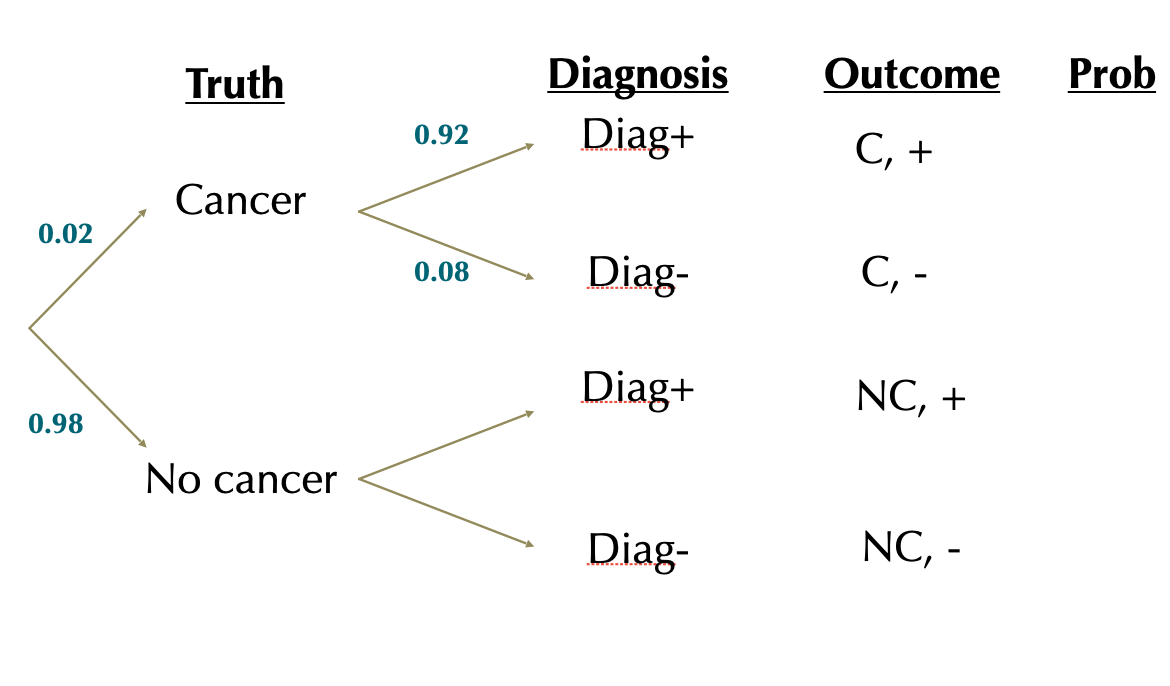
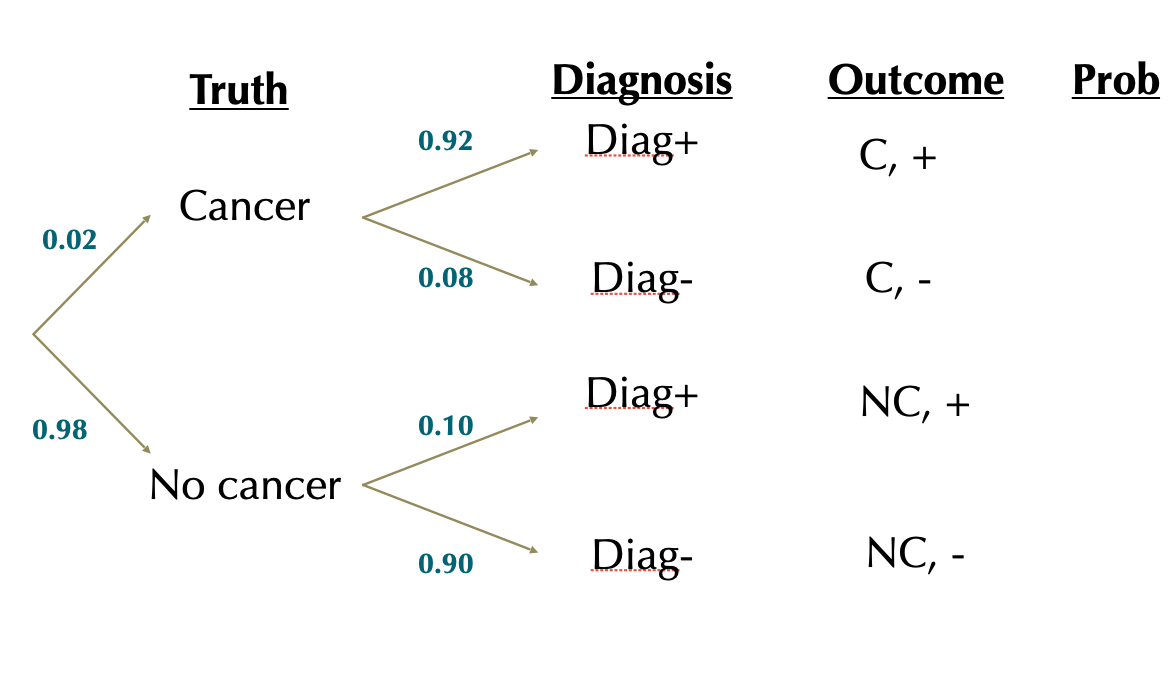
What we know:
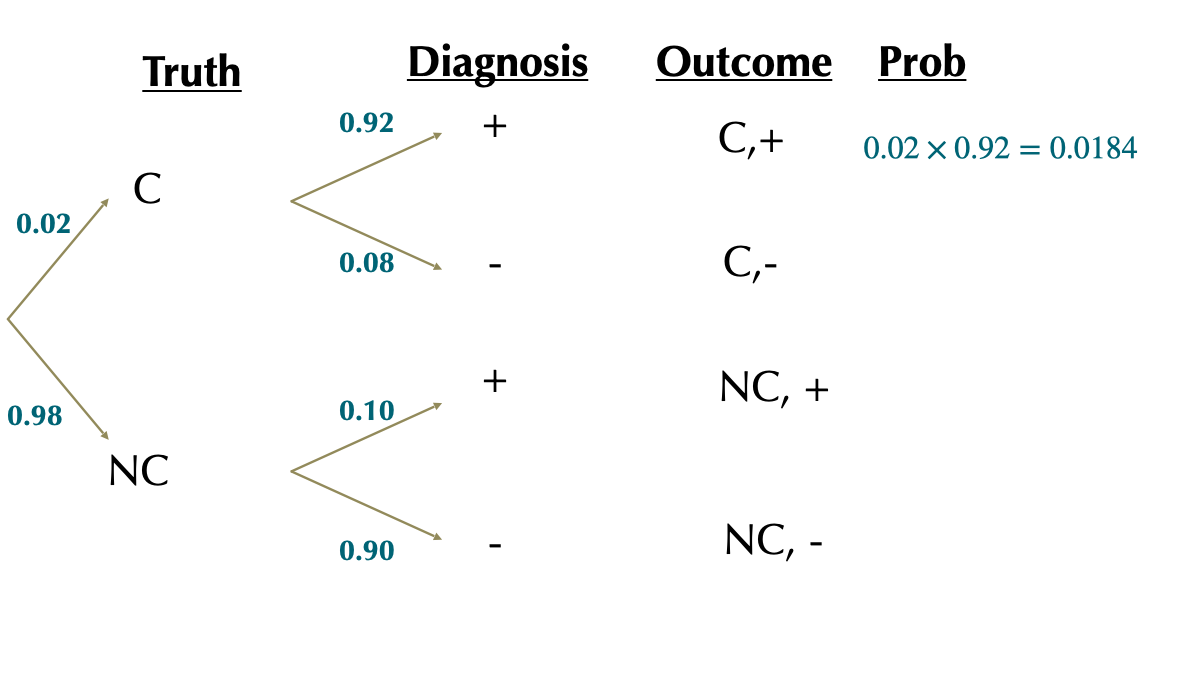
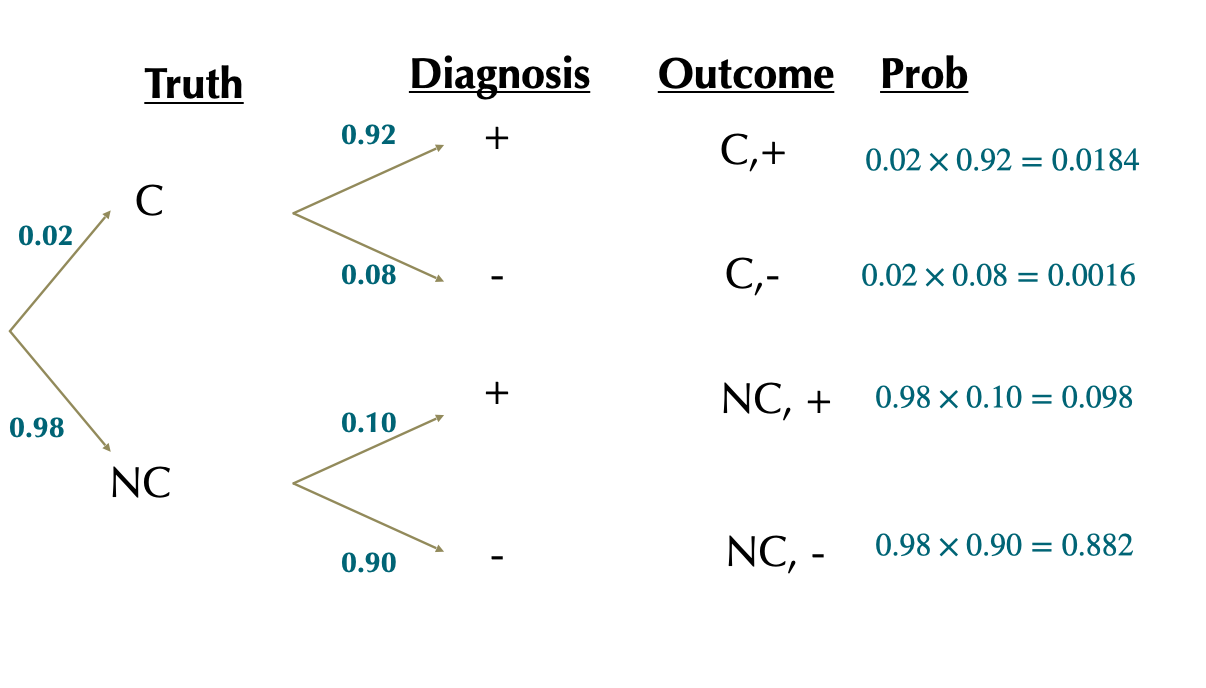
Let \(C\) and \(NC\) be the cancer statuses and \(+\) and \(-\) the test results.
\(P[C]=0.02\)
\(P[NC]=1-0.02=0.98\)
\(P[+|C]=0.92\)
\(P[+|NC]=0.10\)
What we want: \(P[C|+]\) or, in other words, the proportion of positive test cases that are actually true positives
What proportion of + results actually are obtained by C patients?
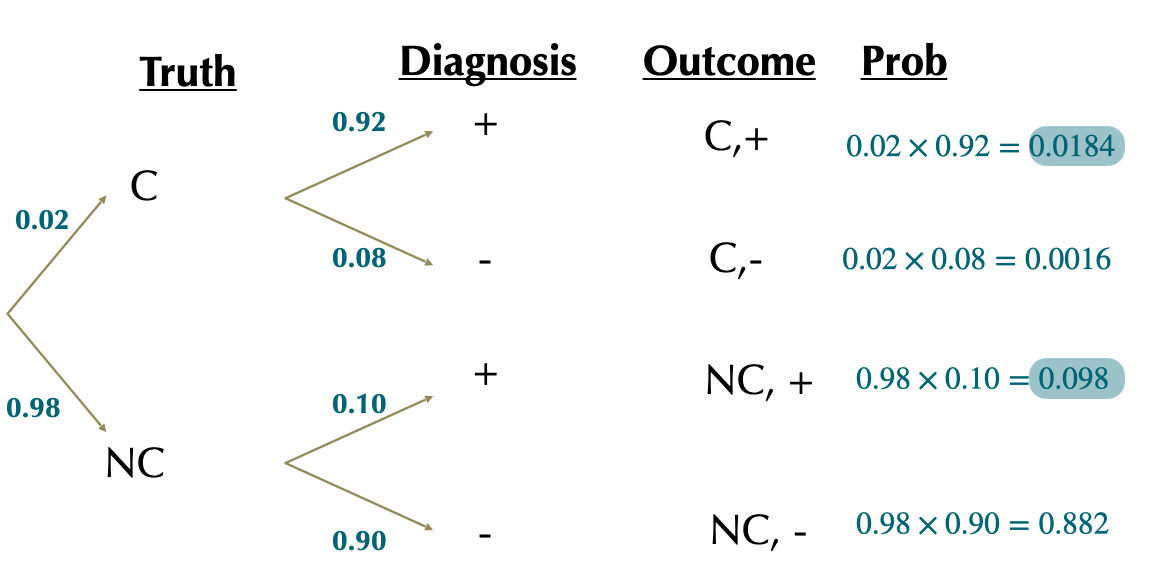
\(\frac{P[C\& +]}{P[+]}\), but what’s \(P[+]\)?
\(P[+]=0.0184+0.098=0.1164\)
Proportion of + tests where there actually is cancer is:
\(= \frac{P[C,+]}{P[+]}=\frac{0.0184}{0.1164}=0.1578\)
Let \(C\) and \(NC\) be the cancer statuses and \(+\) and \(-\) the test results.
\(P[C]=0.02\)
\(P[NC]=1-0.02=0.98\)
\(P[+|C]=0.92\)
\(P[+|NC]=0.10\)
What we want: \(P[C|+]\) or, in other words, the proportion of positive test cases that are actually true positives
So we want: \(P[C|+]=\frac{P[+|C]\times P[C]}{P[+]}\)
We have \(P[+|C], P[C]\), but what about \(P[+]\)?
So we want: \(P[C|+]=\frac{P[+|C]\times P[C]}{P[+]}\)
We have \(P[+|C], P[C]\), but what about \(P[+]\)?
Law of total probability: \(P[+]=P[+|C]\times P[C]+(P[+|NC]\times P[NC]\)
\(P[+]= (0.92\times0.02)+(0.10\times0.98)=0.0184+0.098=0.1164\)
Now we can use Bayes’ theorem: \(P[C|+]=\frac{P[+|C]\times P[C]}{P[+]}\)
\(P[C|+]=\frac{0.92\times 0.02}{0.1164}=0.1580756\approx 0.158\)
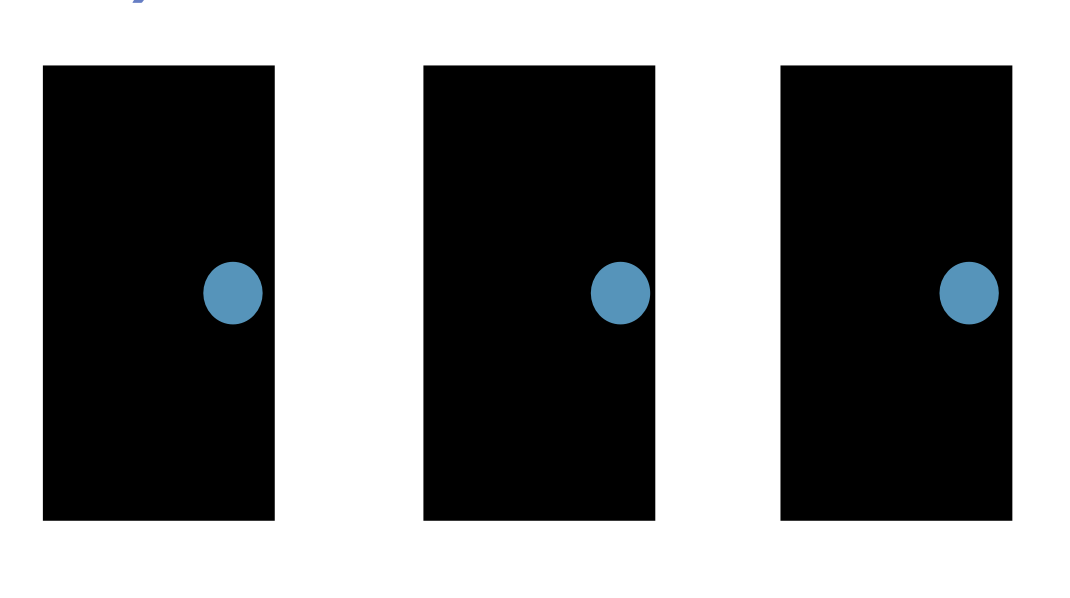
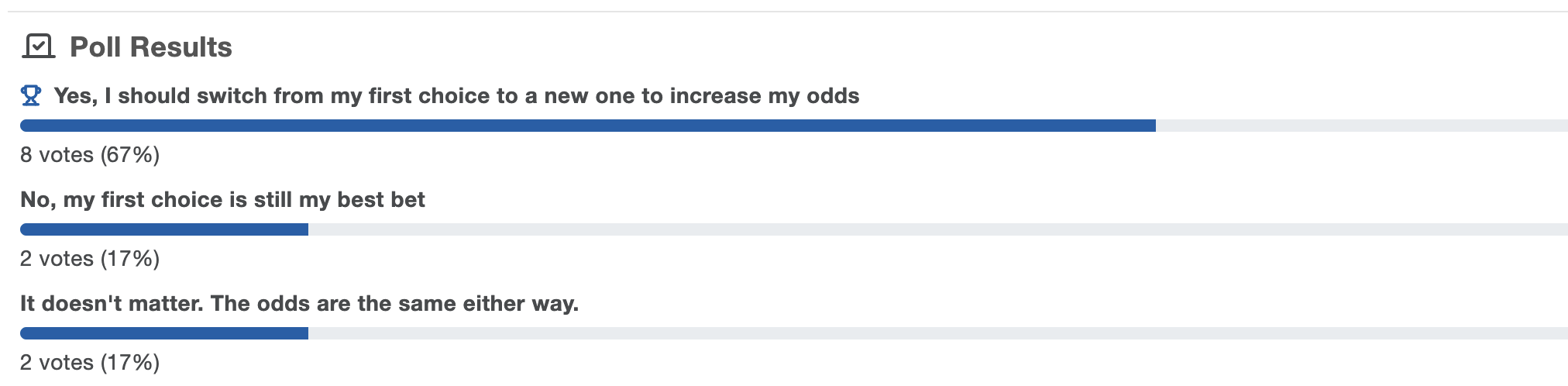
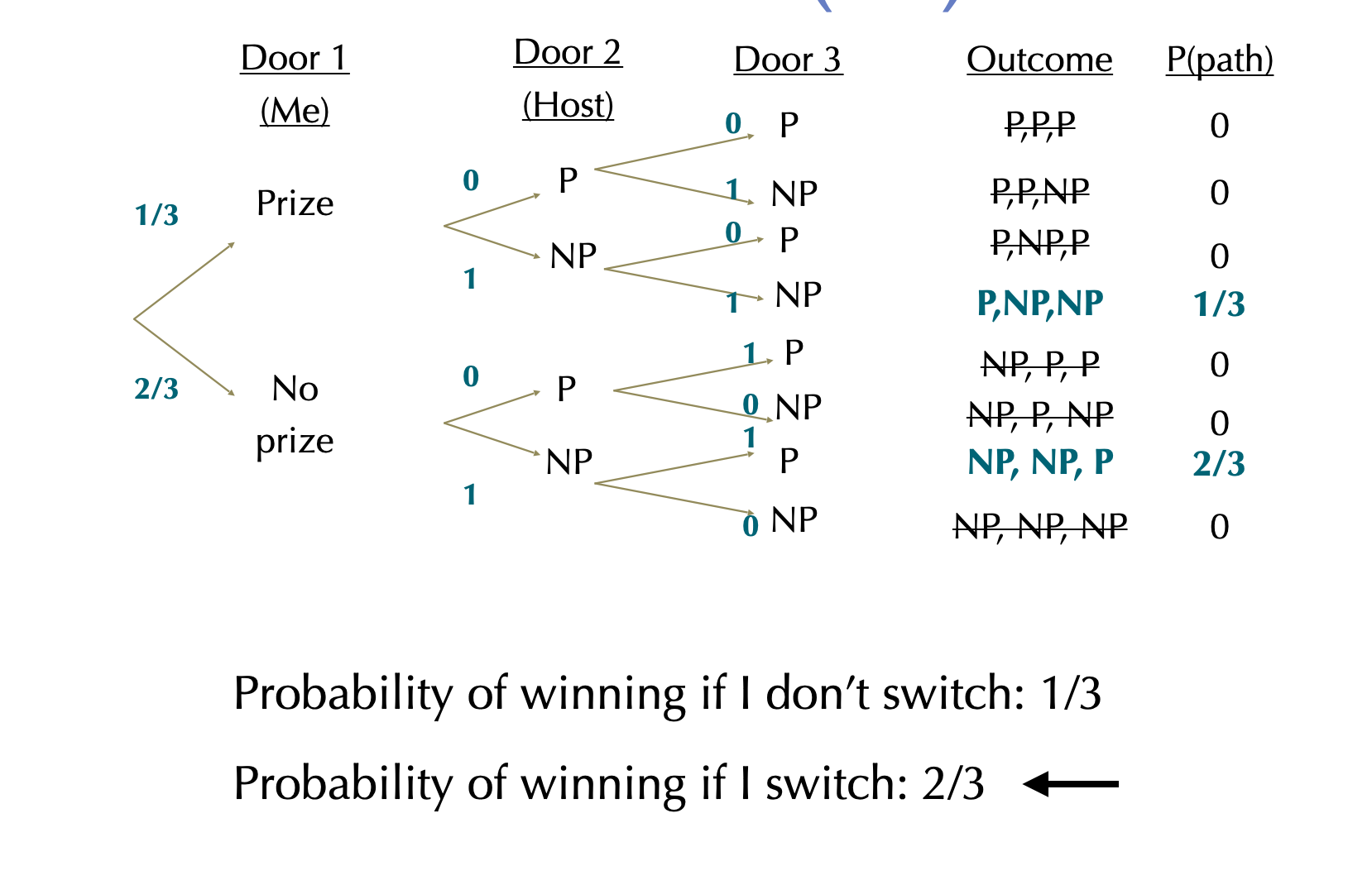
The fatal flaw in the Monty Hall paradox is not taking Monty’s filtering into account, thinking the chances are the same before and after.
But the goal isn’t to understand this puzzle — it’s to realize how subsequent actions & information challenge previous decisions.
Probability theory provides a foundation for rigorous statistics.
Application of simple rules of probability facilitates the generation of more complex predictions.
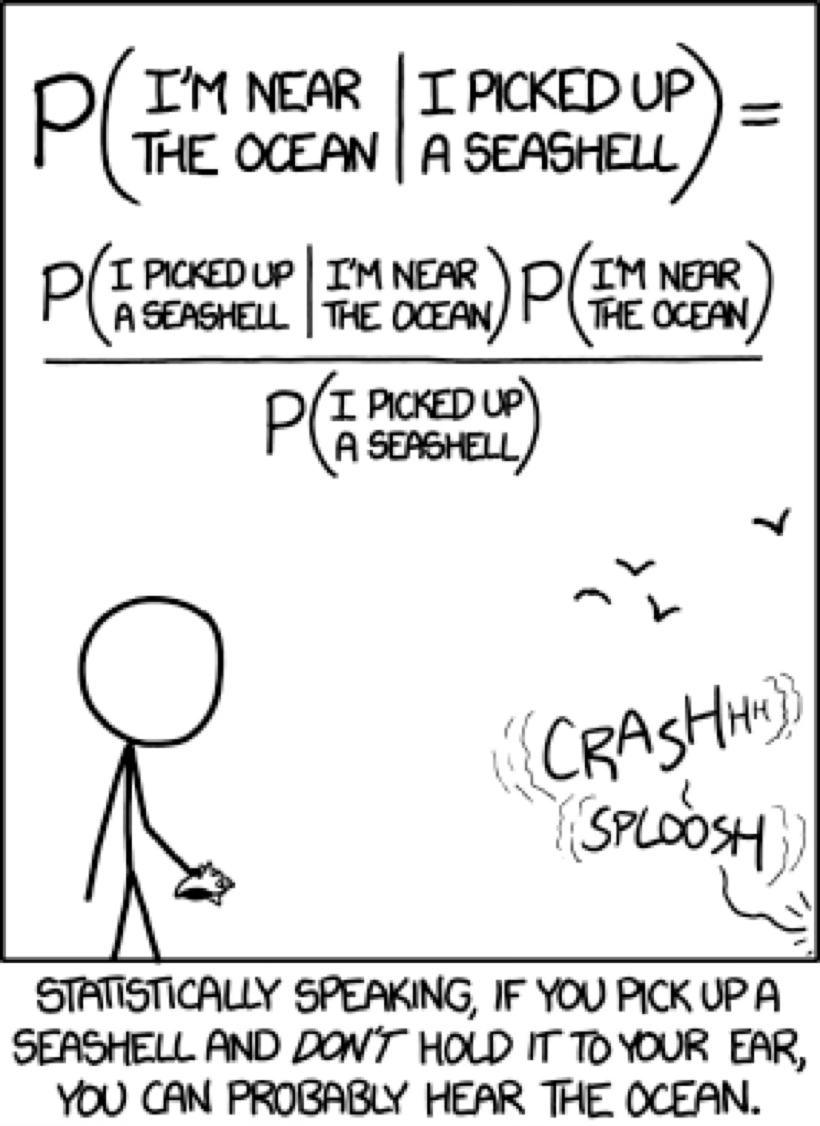
We can use Bayes’ Theorem to translate between probabilistic statements
From: makeameme.org
B215: Biostatistics with R